

Community

News
[October 15, 2025] Building Ships with Eco-Friendly Plastic? Fishing Boats and Rescue Vessels… 16 Already at Sea
"An In-House Venture at Lotte Chemical Puts Innovative Materials to the Test"
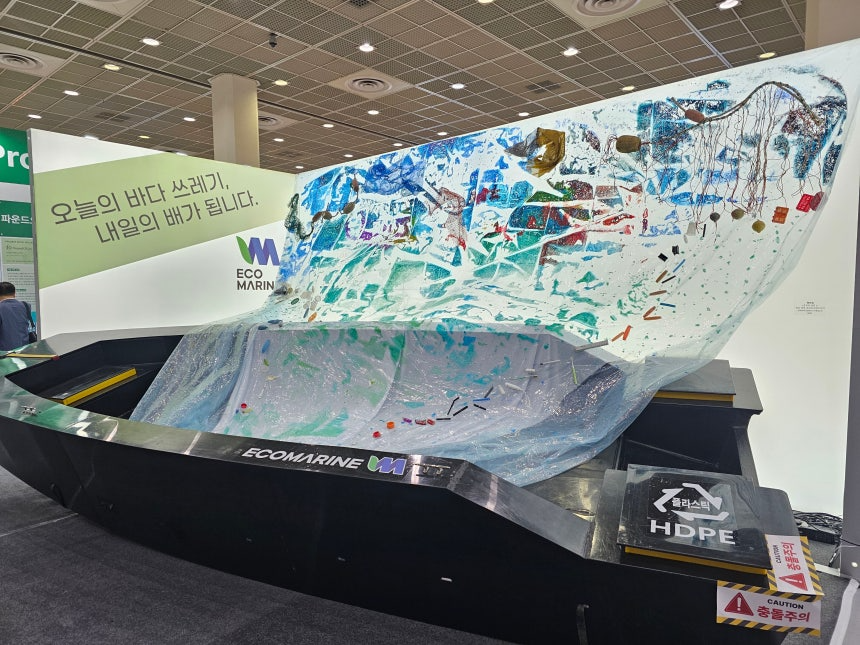
A black boat measuring 6 meters in length and 2 meters in width was displayed at a booth at the Korea ESG Eco-Friendly Expo, held at COEX in Samseong-dong, Seoul, on the 24th of last month. The boat was made from high-density polyethylene (HDPE), a material commonly used to manufacture toys and trash bins. The slogan displayed at the booth, “Today’s Ocean Waste Becomes Tomorrow’s Boat,” particularly caught visitors’ attention. It conveyed the idea that discarded plastic could be recycled and turned into a boat. Curious visitors continued to stop by, asking, “How can you make a boat out of plastic?”
The boat was made from a material developed by EcoMarine, Lotte Chemical’s first in-house venture. Spun off as an independent corporation in 2023, EcoMarine is developing innovative materials for marine applications. The company focused on the limitations of FRP (fiber-reinforced plastic) and aluminum, the primary materials used in conventional vessels.
Currently, approximately 97% of fishing boats in Korea are made from FRP. Although strong due to its combination of plastic resin and fibers, FRP has been identified as a major source of environmental pollution because it generates dust during disposal and is almost impossible to recycle. Aluminum, meanwhile, generates significant carbon emissions during material production.
EcoMarine found its answer in HDPE. Commonly used in everyday products such as shampoo and detergent containers, HDPE is 100% recyclable. Its carbon emissions are also only about 15% of those associated with aluminum. Because HDPE vessels can maintain their appearance without paint, they can eliminate the problem of microplastics generated when paint peels off.
EcoMarine has already built 16 HDPE vessels, including rescue boats, high-speed boats, and fishing boats. These vessels are currently in operation at locations such as Pyeongtaek Port and by maritime authorities, demonstrating their performance in real-world conditions.
One drawback of HDPE vessels is that their construction costs are approximately 15% higher than those of FRP vessels. To address this issue, EcoMarine is building its first company-owned factory in Hwaseong, Gyeonggi Province.
Maeng Gwang-hee, a director and founding member of EcoMarine, said, “By manufacturing high-quality, large-scale products in-house and reducing welding processes and labor costs, we believe we can bring vessel construction costs down to the level of FRP vessels.”
EcoMarine recorded revenue of KRW 260 million in 2023 and KRW 1.19 billion in 2024, demonstrating rapid growth. With a revenue target of KRW 20 billion by 2028, the company has also begun expanding overseas.
Recently, EcoMarine signed an MOU with a Malaysian defense company and launched a joint project to manufacture HDPE vessels locally.
- Headquarter 306, 3F, 60 Dunji-ro, Seo-gu, Daejeon, Republic of Korea
- Seoul Office 13F, 122, Mapo-daero, Mapo-gu, Seoul
- Factory 42-1 Gakgeum 2-gil, Seonghwan-eup, Seobuk-gu, Cheonan, Chungcheongnam-do
- Business Registration Number 322-86-02936
- TEL +82 41-582-2542
- FAX +82 41-583-2542
- E-MAIL ceo@ecomarine.kr


