

R&D

Main Research
Functional materials R&D
Tailored to each hull zone
01. Anti-fouling material development
(marine growth control)
Keeping marine life off the hull improves fuel economy, cuts greenhouse gas emissions, and lowers maintenance such as cleaning and recoating.
- Biofouling can raise a vessel’s GHG emissions by up to 55%; anti-fouling materials are developed to mitigate these impacts.
- Research samples produced in collaboration with LG Electronics
- Marine growth testing underway with Korea Maritime Equipment Research Institute (KOMERI) (through April 2025)
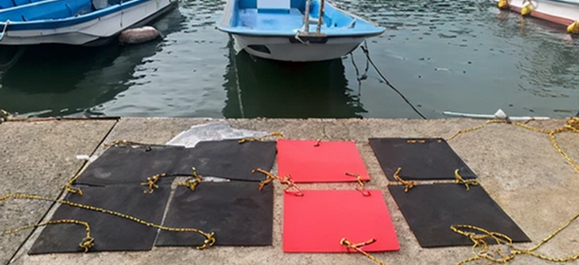
Specimen preparation and marine growth evaluation
for anti-fouling testing
02. High-quality recycled
HDPE composite research
High-grade recycled HDPE compounds that use recycled feedstock while keeping performance variation tight, supporting circularity and lower carbon in maritime.
- HDPE grades for ship applications using post-consumer recycled (PCR) content
- PCR supply value chain secured; property testing completed
- Pursuing Global Recycled Standard (GRS) certification (target ~2026)

GRS certification logo (certification targeted by 2026)

03. High-heat, low-shrink composites for engine spaces
Materials with higher heat resistance for hot engine-bay conditions and minimal shrinkage and warpage during forming and service.

04. Wheelhouse anti-static research (Anti-Static)
Materials that limit electrostatic buildup around the bridge and electronics, protecting instrumentation and controls and improving operational safety.

05. Outer-shell fire-retardant research
Fire-retardant solutions for hull exteriors to improve safety in a fire and reduce smoke and heat release.

06. Welding and thermoforming–compatible processes
Materials used across the hull are designed to stay compatible with welding and thermoforming so they fit real shipyard and production workflows.
Functional materials development workflow

STEP 01
Front-end research

STEP 02
Formulation design

STEP 03
Material production trial

STEP 04
Property analysis
(composition, mechanical, thermal)

STEP 05
Extrusion & forming of stock
(sheet, welding rod, etc.)

STEP 06
Material production trial
(hull prototypes,
class society certification tests)
Dedicated materials R&D
Dedicated 3D printing materials for ships
We develop dedicated 3D printing feedstocks and prototypes based on high-performance HDPE compounds for eco-friendly ships and parts.
Proprietary feedstock development and prototype builds are underway in parallel,
with domestic and international partners on technology and business collaboration
to commercialize 3D-printed boat production.
Core research themes include stronger interlayer adhesion in 3D printing
and minimizing process shrinkage and distortion.
Dedicated materials development workflow
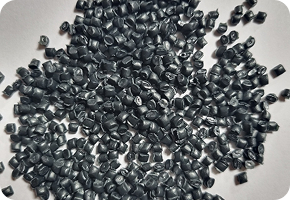
STEP 01
Feedstock development
HDPE material development for 3D printing
- Rheological behavior and processability review
- Additive formulation design for printability
- Production of dedicated 3D printing feedstock
- Basic property testing (MFR, tensile strength, etc.)
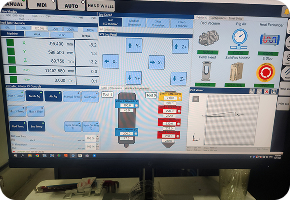
STEP 02
Process parameters
Optimization of build parameters and process conditions
- Tuning nozzle and bed temperatures, layer thickness, and related settings
- Print trials and defect root-cause analysis
- Stabilized 3D printing process
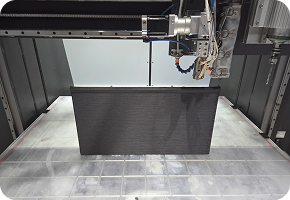
STEP 03
Build & validation
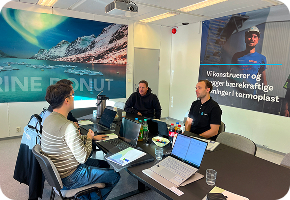
Prototype printing and validation with 3D scanning
- Prototypes built from part drawings provided by HD Hyundai Samho
- Dimensional and defect inspection via 3D scanning
- Prototypes completed to near production-ready quality
STEP 04
Commercialization
Building blocks such as an overseas partner network
- Stakeholder feedback after sharing prototype results
- Follow-on collaboration with overseas partners
- Exploring expansion of PoC part families
- Headquarters 306, 3F, 60 Dunji-ro, Seo-gu, Daejeon, Republic of Korea
- Research Institute 701, Main Building, Seoul Startup Hub, 21 Baekbeom-ro 31-gil, Mapo-gu, Seoul, Republic of Korea
- Business Registration Number 322-86-02936
- TEL +82-41-582-2542
- FAX +82-50-4244-9484
- E-MAIL ceo@ecomarine.kr


