

Community

News
[July 1, 2026] Ewha Womans University Successfully Hosts NGO–Corporate Matching Day to Explore Field-based Collaboration Models
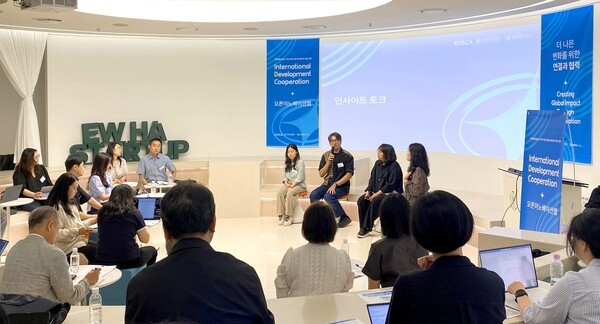
Ewha Womans University (President Lee Hyang-sook) successfully hosted the International Development Cooperation (IDC) Open Innovation Lab Corporate–NGO Matching Day on Tuesday, June 30, at the university’s Startup Open Space.
The matching day was part of the Systematization of a Foundation for Enhancing the Sustainability of Income Generation Projects for Vulnerable Groups, a project being implemented under the Korea International Cooperation Agency (KOICA) Development Alliance Korea (DAK) Policy Cooperation Program. The event was designed to establish a practical foundation for collaboration between NGOs with experience in international development and social economy organizations, startups, and small and medium-sized enterprises (SMEs) with innovative products, services, and business models.
Approximately 60 representatives from 21 international development NGOs, including the Milal Welfare Foundation and Together with Love Field, and 24 social economy organizations, startups, and SMEs, including Mobinity, EcoMarine, and CrossHub, participated in the event. The participating organizations discussed potential collaboration across various fields, including education, healthcare, rural development, climate and the environment, water, sanitation and hygiene (WASH), digital transformation, income generation, and disability inclusion.
The morning program began with presentations on corporate–NGO open innovation and collaboration cases. Panelists included Jeon Ji-min, Director of the Canaan World Leadership Training Center under the World Canaan Movement; Park Jung-yeol, CEO of Jerrybag; and Cha Hong-sun, CEO of Cornerstone T&M. They shared their experiences of collaboration in international development settings and discussed the potential of corporate–NGO partnerships. This was followed by an insight talk and Q&A session moderated by MY Social Company (MYSC), during which participants discussed the principles and conditions for successful collaboration, considerations throughout the partnership process, partner selection criteria, and practical advice for follow-up cooperation.
In the afternoon, the main matching and networking program took place. Based on prior applications, participating organizations were divided into thematic groups to explore potential collaboration in areas such as digital health and healthcare; water, sanitation, housing, and basic infrastructure; resource circulation, waste management, and carbon reduction; rural development; income generation and vocational training; disability and inclusion; and education and digital transformation.
Each group focused on identifying opportunities to connect NGOs’ field networks and understanding of beneficiaries with companies’ technological expertise, products, services, and business capabilities. In particular, discussions went beyond simple networking to explore concrete possibilities for local proof-of-concept (PoC) projects, joint project planning, links to relevant KOICA programs—including Civil Society Cooperation, Inclusive Business Solution (IBS), and Creative Technology Solution (CTS) programs—and follow-up meetings.
The event continued with one-on-one networking between organizations and a Fast-Pitch session, where participants presented collaboration ideas. Interested organizations shared their proposals and discussed the possibility of follow-up meetings. Toward the end of the event, participants prepared letters of intent to confirm next steps for joint project planning and partnership development.
The event was significant in that it explored an open innovation collaboration model in which companies and NGOs move beyond the conventional relationship of donor and implementing organization to jointly identify, test, and scale solutions to social challenges based on their respective strengths. NGOs can contribute their understanding of local issues and beneficiary needs, along with regional networks, while companies can combine their technologies, products, services, data, and business capabilities to develop sustainable international development cooperation models.
Professor Kang Min-a of Ewha Womans University said, “To enhance the sustainability of international development cooperation, it is important for NGOs with an in-depth understanding of local communities and companies with innovative capabilities to work together to define problems and develop practical collaboration models. We hope this matching day will serve as a starting point for building a new collaboration ecosystem based on the social and solidarity economy in the field of income generation for vulnerable groups.”
Meanwhile, the matching day was held as part of a project jointly implemented by Ewha Womans University and MY Social Company (MYSC). The project aims to systematize international development cooperation models based on the social and solidarity economy, foster a corporate–NGO collaboration ecosystem, and establish a foundation for measuring social value and ensuring sustainable expansion.
- Headquarter 306, 3F, 60 Dunji-ro, Seo-gu, Daejeon, Republic of Korea
- Seoul Office 13F, 122, Mapo-daero, Mapo-gu, Seoul
- Factory 42-1 Gakgeum 2-gil, Seonghwan-eup, Seobuk-gu, Cheonan, Chungcheongnam-do
- Business Registration Number 322-86-02936
- TEL +82 41-582-2542
- FAX +82 41-583-2542
- E-MAIL ceo@ecomarine.kr


