


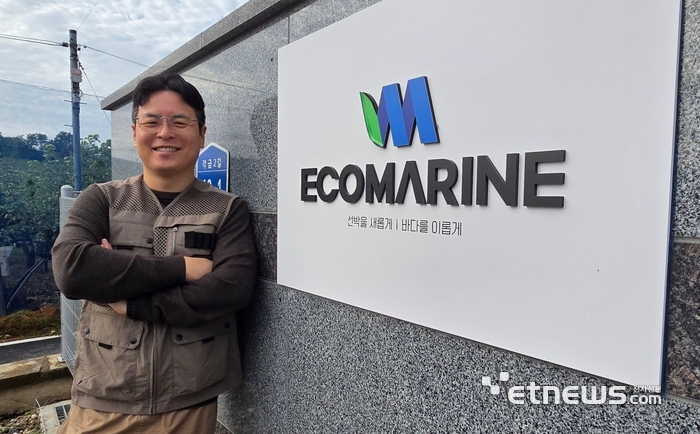
EcoMarine, an eco-friendly marine materials company led by CEO Park Deok-hun, is commercializing recyclable high-density polyethylene (HDPE) materials for vessels. Its materials are being tested at sea on 17 vessels in Korea and overseas, and the company plans to expand into the market after completing trials on fishing vessels this year.
Fiber-reinforced plastic (FRP), widely used in small vessels, is difficult to recycle at the end of a vessel’s service life, creating challenges for decommissioning and disposal. EcoMarine is developing technology to replace conventional hull materials with HDPE and recover retired vessels to recycle them into raw materials for new vessels.
HDPE is a corrosion-resistant material that can be recycled after a vessel is decommissioned. EcoMarine aims to reduce the resources required for hull maintenance and lower fuel consumption by leveraging the material’s lightweight properties and buoyancy. However, determining how much carbon emissions can be reduced compared with conventional materials requires an assessment of the entire life cycle, from raw material production through manufacturing, operation, and end-of-life disposal.
Strength and durability are critical when recycled plastics are reused in vessels. Because hull integrity is directly related to safety, variations in the quality of recycled feedstock must also be carefully controlled. EcoMarine has developed its proprietary technology, Upcycled Recycled Polyethylene (UrPE), which converts waste HDPE vessels and post-consumer plastic packaging into recycled materials for vessel manufacturing. Rather than limiting recycled materials to selected parts of a hull, the company aims to expand their use throughout the entire structure. It has also obtained Global Recycled Standard (GRS) certification, an international standard related to recycled materials.
EcoMarine is advancing Re-Float, a circular resource model in which retired HDPE vessels are collected and dismantled, and their hulls are processed into recycled feedstock for manufacturing new vessels. Having developed the recycling technology, the company’s next challenge is to establish a reliable system for recovering end-of-life vessels.
EcoMarine plans to build a system to track each vessel throughout its life cycle, from construction and operation to maintenance and decommissioning. By accumulating vessel-specific data, the company aims to predict when vessels should be recovered and convert dismantled hulls into UrPE feedstock. It is also pursuing a plan to operate an HDPE vessel recovery center at an eco-friendly fishing vessel construction support complex scheduled to be established in Mokpo in 2029.
The company is also researching materials that can reduce marine organism attachment to hulls, as accumulated growth can affect operational efficiency. In addition, it is exploring 3D printing for hull manufacturing, targeting markets with diverse vessel types and relatively low production volumes, such as defense and recreational vessels.
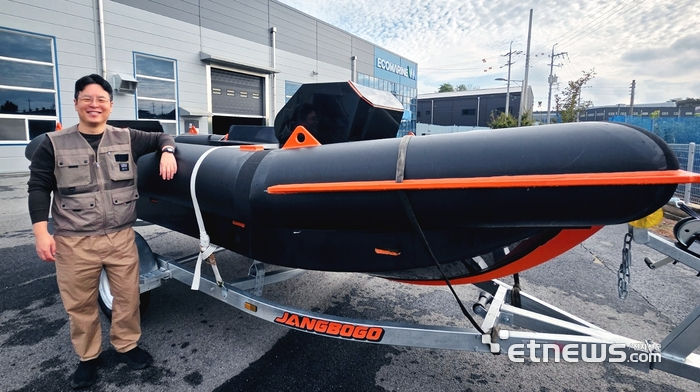
EcoMarine is conducting sea trials using its products on 17 vessels, including 16 in Korea and one in Malaysia. The company plans to complete trials of HDPE fishing vessels, its primary target market, by the end of this year. To date, it has secured a cumulative KRW 3.2 billion in investment and generated approximately KRW 2.5 billion in cumulative revenue.
The company has used its investment funding to establish its own production facility and is preparing its manufacturing equipment and relevant certifications. In Korea, it is working with 12 HDPE shipyards to enter the fishing vessel market. Overseas, it has established partnerships with approximately five shipyards and is exploring opportunities in defense and special-purpose vessel markets.
EcoMarine has signed an export contract worth approximately KRW 120 million with a Dutch company and is preparing to ship the products. It is also developing special-purpose vessels in Malaysia. However, plans for approximately 200 vessels currently under discussion in the Malaysian market will depend on the results of the ongoing trials.
EcoMarine joined the 2026 Gyeonggi Province Climate Tech Startup Development Program, operated by Gyeonggi Province and the Gyeonggi Center for Creative Economy & Innovation, to quantify the environmental benefits of HDPE vessels. Having demonstrated the technical feasibility of recycling end-of-life vessels, the company recognized the need for evidence to verify how much environmental impact could actually be reduced compared with conventional FRP vessels.
Through the program’s Green Scale-Up initiative, EcoMarine is receiving support for a life cycle assessment (LCA) of HDPE vessels. The assessment examines environmental impacts at each stage, including raw material production, vessel manufacturing, operation, end-of-life disposal, and recycling, with the aim of developing objective data for commercialization. The assessment is still underway, and no definitive carbon reduction figure has yet been established through the program. EcoMarine plans to use the results to improve its materials and demonstrate their value to customers.
CEO Park Deok-hun said, “I founded the company out of a sense of mission to contribute to the environment and leave a better environment for future generations. Working with the Gyeonggi Center for Creative Economy & Innovation, we will strive to demonstrate that eco-friendly businesses can also be economically viable and help create opportunities for more climate tech startups to emerge.”
공동기획: 경기창조경제혁신센터·전자신문
수원=김동성 기자 estar@etnews.com


